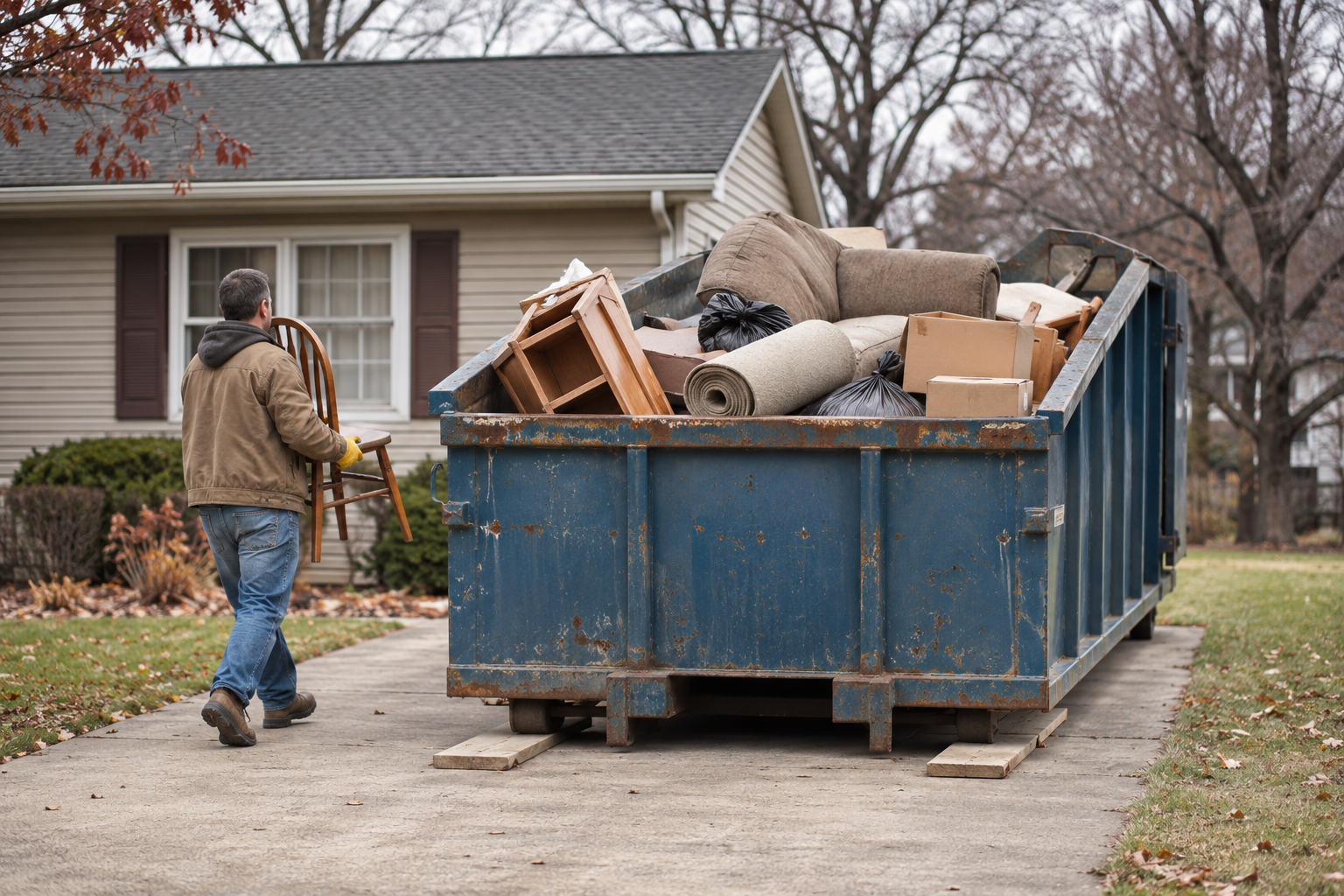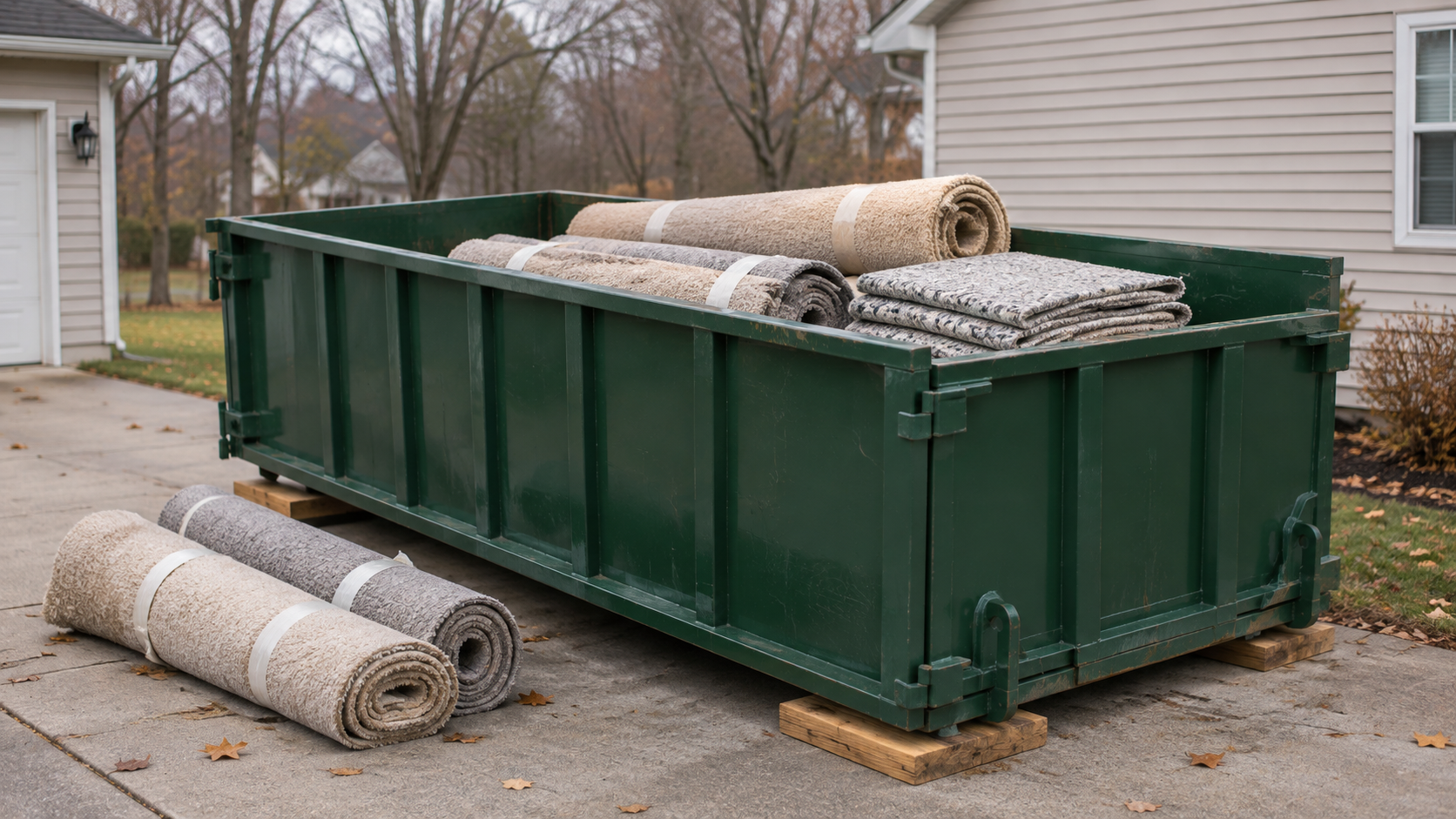
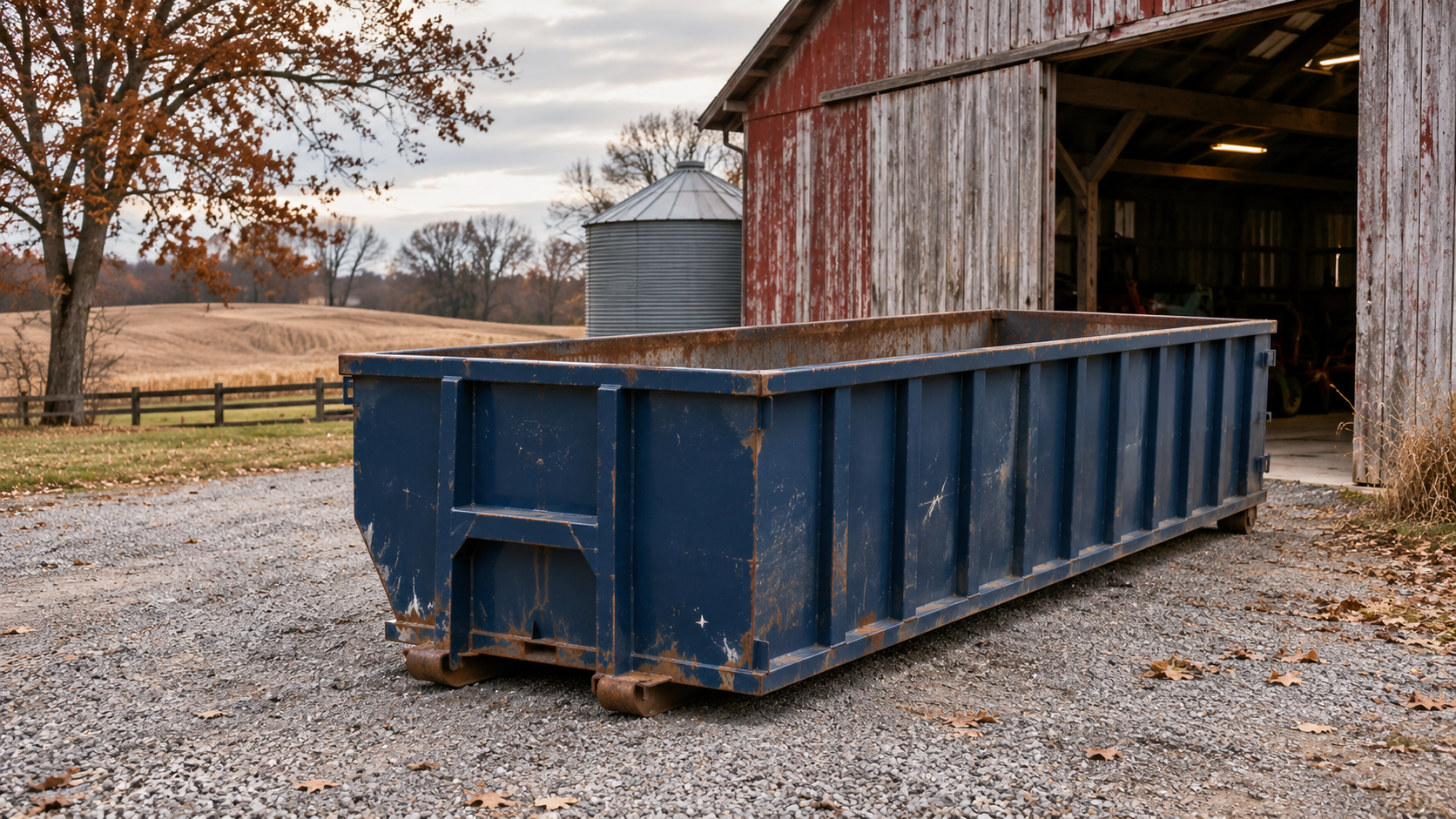
Once the combine is parked and the bins are full, a lot of farm families and acreage owners across the Cedar Valley finally get a few weeks to deal with everything that has piled up over the years. 3D Solutions, Inc. is a roll-off dumpster rental company based in Denver, Iowa, operating out of a Waterloo yard, and late fall is when rural cleanouts pick up: machine sheds, lean-tos, and the junk pile behind the grove.
A 30-yard roll-off dumpster parked on a firm spot near the buildings turns that job into a few weekends of carrying and stacking instead of trip after trip to the landfill with a pickup and trailer. This guide covers what goes in, what stays out, how to pick a size, and where the container should sit on a farm or acreage so the ground and the truck both hold up.
When Is the Best Time for a Farm or Acreage Cleanout?
The best window for most farms and acreages is right after harvest and before the ground freezes. Field work is done and a gravel yard is usually still easy to get around. Booking before the first hard freeze also means the delivery path is less likely to be blocked by snow or ice.
The rental includes 14 days, and the delivery day counts as day 1. Before the container arrives, walk every building, decide what stays and what goes, and line up help for the weekends inside that window, since all loading is done by hand.
What Can Go in a Farm Cleanout Dumpster?
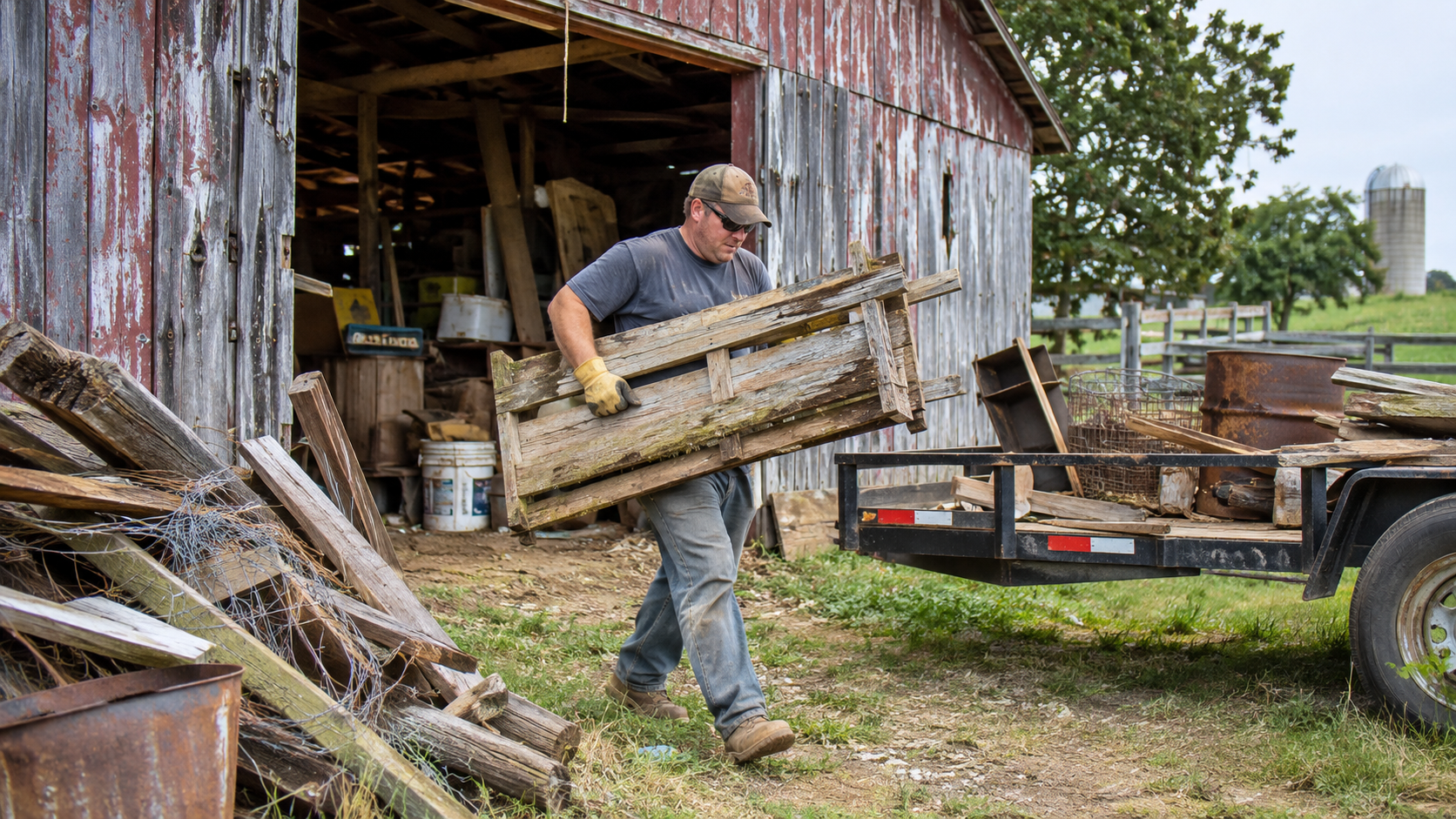
Most dry, solid junk from a farm or acreage can go in a roll-off. Old lumber, wood fencing, broken furniture, shed clutter, roofing materials, mattresses, household junk, and electronics are all accepted. If it is dry, solid, and you can lift it in by hand, it is usually fine.
Common examples from a rural cleanout:
- Old boards, pallets, and wood fence rails
- Rotted shelving, workbenches, and cabinets from the shop
- Worn-out couches, chairs, and mattresses stored in outbuildings
- Old shingles and roofing material from sheds or a farmhouse reroof
- Boxes, broken tools, plastic tubs, and general household junk
- Old TVs, computers, and other electronics
Scrap metal and machinery parts are a common question on farms. 3D Solutions does not publish a set policy on them, so ask when you book before you plan to fill the container with steel, wire, or old implement parts.
If the plan is to tear down a whole structure rather than empty it, our guide to dumpsters for deck, shed, and fence removal covers that kind of demolition project in more detail.
What Has to Stay Out, and Where Does It Go Instead?
Tires, chemicals, paint, batteries, liquids, concrete, dirt, and bricks have to stay out of the dumpster. These are prohibited, and if a load contains material the truck cannot haul, the customer has to empty it and may incur charges. Farm chemicals and old pesticide containers need to go through your county solid waste authority or follow Iowa DNR guidance instead.
Tires are the item that turns up most often on farms. Iowa has prohibited land disposal of waste tires since 1991, and the Iowa DNR waste tire guidance explains that tires cannot be dumped, buried, or burned. The usual route is a tire dealer or a hauler registered with the DNR. Options and fees vary by county, so confirm locally.
Old pesticide jugs, herbicide containers, and leftover farm chemicals should not go in a roll-off under any circumstances. Follow the disposal directions on the product label and ask your county solid waste authority what it accepts. Our guide to household hazardous waste disposal covers the general approach, but keep in mind that household programs may not take products used on a working farm, so call before you drive anything over.
Older outbuildings can also hide asbestos in siding, insulation, or old floor tile. Asbestos is never accepted. If you suspect it, leave the material alone and have it tested before anyone starts tearing it out.
| Item group | Allowed in the dumpster? | What to do instead |
|---|---|---|
| Old lumber and wood fencing | Yes | Load by hand and lay long pieces flat. Ask at booking about wire, steel posts, or other metal. |
| Shed junk (dry, solid items) | Yes | Sort out anything hazardous first. |
| Furniture and mattresses | Yes | Break down bulky pieces so they stack tighter. |
| Tires | No | A tire dealer or a DNR-registered waste tire hauler. Confirm options with your county. |
| Pesticide and chemical containers | No | Follow the product label and ask your county solid waste authority or Iowa DNR. |
| Used oil and fuel | No | Liquids and flammable liquids are prohibited. Ask your county about local drop-off options. |
| Batteries | No | Ask your county solid waste authority about recycling. |
| Dirt and concrete | No | Ask your county or city about rubble or fill sites. |
Why Does a Roll-Off Have to Be Loaded by Hand?
3D Solutions containers are loaded by hand only, not with machinery. A skid loader, tractor bucket, or telehandler can dent the walls, crack the floor, or shove the container off its boards. Negligent damage can make the customer liable for the repair.
Hand loading goes faster than most people expect with a plan:
- Start with the heaviest, flattest items on the floor and spread them out.
- Stack lumber and fence boards lengthwise along the 22-foot side.
- Keep the load even from end to end so nothing sticks up over the sides.
Using a tractor or gator with a wagon to move junk from a far building to the container is fine. The machine just should not be the thing putting debris into the dumpster.
Is a 20-Yard or 30-Yard Better for an Acreage Cleanout?
For a cleanout that covers a machine shed plus one or two outbuildings, the 30-yard is usually the safer pick. It holds up to 12 pickup truck loads for a flat rate starting at $355. The 20-yard holds up to 8 pickup truck loads, starts at $335, and suits a single shed or one junk pile.
Both containers have the same 22-foot by 8-foot footprint, so they need the same space on the ground. The difference is wall height: 4 feet on the 20-yard and 6 feet on the 30-yard. For only $20 more at the starting rate, the 30-yard gives you room for up to 4 more truck loads, which matters when the full mess only shows once you start pulling things out.
| Size | Dimensions | Capacity | Flat rate | Good fit for |
|---|---|---|---|---|
| 20-yard | 22 ft x 8 ft x 4 ft | Up to 8 pickup truck loads | From $335 | One shed, one junk pile, or a short stretch of old fence |
| 30-yard | 22 ft x 8 ft x 6 ft | Up to 12 pickup truck loads | From $355 | A machine shed plus outbuildings, or a whole-acreage cleanout |
Keep weight in mind as well as volume. Weight is billed at $43 per ton based on the landfill weigh ticket, and old wet lumber, roofing, and dense shop junk add up faster than furniture or boxes. Tax is added at checkout on top of the flat rate.
Where Should the Dumpster Sit on a Farm or Acreage?
The dumpster should sit on a firm, level surface that can bear the weight of a loaded container, such as a gravel yard, a concrete pad, or a hard-packed lane. The spot needs to be at least 15 feet long by 10 feet wide. Do not plan on a field, pasture, or lawn, since soft ground is where trucks and containers get into trouble.
Protective boards go under the container, but they do not turn soft soil into a solid base. On most farms the best spot is the gravel area between the house and the machine shed, close enough that you are not carrying junk across the whole yard. If you are worried about a concrete apron or a paved section, our article on whether a dumpster will damage your driveway walks through what to expect.
Before delivery day, move equipment and wagons out of the lane, look up for power lines and low branches near the drop spot, and mark any septic tank or well head nearby.
How Does Delivery Work for Rural Addresses in the Cedar Valley?
Rural delivery works the same way it does in town. You book online, choose your delivery and pickup dates, and describe exactly where the container should go during checkout. Delivery typically happens within 24 to 48 hours, with same-day sometimes possible depending on location and demand.
Deliveries run between 8 AM and 8 PM. Sundays are closed on the booking calendar, and Saturdays show “Call For Availability.” The checkout asks where you would like the dumpster dropped. On a farm, name the building, the side of it, and the lane or gate to use.
3D Solutions is anchored in Bremer and Black Hawk counties and serves 25-plus communities across the Cedar Valley, including rural areas around towns like Tripoli, Readlyn, Fairbank, Dunkerton, Sumner, and Janesville. You can check the full service area list. If your acreage sits outside the towns listed there, call before booking to confirm delivery.
Key Takeaways
- Plan the cleanout for the window between harvest and the first hard freeze, when the yard is dry and solid.
- Both sizes share a 22 by 8 foot footprint, so choose by wall height and how much you are clearing.
- Old outbuildings can hide asbestos in siding or insulation. Have suspect material tested and keep it out of the load.
- Place the container on gravel, concrete, or a hard-packed lane with at least 15 by 10 feet clear, never on a field or lawn.
- Ask at booking before loading scrap metal or old machinery parts.
Farm Cleanout Dumpster FAQs
Do I need to be home when the dumpster is delivered to my farm?
No, you do not need to be home as long as the placement area is clear and you gave placement instructions at checkout. The driver can drop the container while you are out in the field, and you can start loading when you get back.
Can an old chest freezer or refrigerator from the shed go in the dumpster?
Appliances carry a $75 surcharge per item. 3D Solutions has no stated policy on appliances that contain refrigerant, such as freezers, refrigerators, and air conditioners, so confirm how those are handled when you book.
What if the cleanout takes longer than 14 days?
Extra days cost $15 per day for both the 20-yard and the 30-yard. The delivery day counts as day 1 of the 14 included days, so count from the delivery date when you pick your pickup date.
Do I need a permit to put a dumpster on my own acreage?
A dumpster on your own private property typically does not need a permit. Placement on a public road or right-of-way may require one, and rules vary, so check with your county or city before setting it anywhere off your land.
What happens if the dumpster fills up before we are done?
Swap-outs are available during the rental. A full container can be hauled away and replaced with an empty one, so call when you see it getting close to full.
When do I pay for a farm cleanout dumpster?
Payment is due on or before delivery. Once a reservation is paid it cannot be refunded, so settle your delivery and pickup dates before you check out.
Will you deliver to a farm outside the listed service towns?
Possibly, but it is not guaranteed. Call (319) 406-0043 or email [email protected] with your address before booking, and the team can tell you whether your location can be served.
Ready to clear out the machine shed and outbuildings before winter sets in? Book your roll-off online in a few minutes, or contact 3D Solutions at (319) 406-0043 if you want help choosing a size or checking delivery to your acreage.