A garage cleanout dumpster gives homeowners and contractors a fast way to reclaim space, reduce fire and trip hazards, and stop a clutter problem from spreading into the driveway, basement, or yard. It solves the main bottleneck in any serious cleanout: too much mixed debris for curbside trash and too many trips for a pickup truck. In Denver, Iowa and nearby communities like Waterloo, Cedar Falls, and Waverly, the right roll-off can turn a stalled project into a one-weekend win. The key is choosing the right size, loading it correctly, and knowing what local renters usually overlook.
How do you know you need a garage cleanout dumpster?
You need a dumpster when the garage contains bulky, mixed debris that will not fit in weekly trash carts. In Denver and Cedar Falls, one roll-off often replaces several truck trips, cuts lifting risk, and keeps the cleanup moving on your schedule.
A good rule is volume first, convenience second. If your garage cleanout includes broken shelving, old furniture, bags of trash, boxes of unknown contents, yard tools, or leftover remodeling debris, a dumpster is usually the simplest answer. Most curbside programs are built for routine household waste, not years of overflow.
If the pile would take more than two pickup loads, or if you need the garage cleared before a move, remodel, or inspection, a roll-off becomes the practical option. Common misconception: people assume donation and curbside pickup will handle most of it. In reality, reusable items are often a small share of the total once the sorting starts.
What dumpster size is best for most garage cleanouts?
For most one-car and two-car garages, a 20-yard roll-off is the best starting point. 3D Solutions, Inc. and other local haulers use this size for medium home cleanups because it balances driveway fit, manageable wall height, and enough volume for mixed household junk.
The 20-yard container offered by 3D Solutions, Inc. measures about 22 feet by 8 feet by 4 feet and starts at $335, with up to 14 days included. That profile works well when you are hand-loading boxes, plastic bins, shelving, and small furniture. Lower side walls matter more than many people expect after the first hour of loading.
A 30-yard dumpster gives you more room for overflow situations, larger garages, or a cleanout that includes attic, basement, or shed debris at the same time. Since the 30-yard starts at $355, the price jump is small. The trade-off is height. A 22 feet by 8 feet by 6 feet container holds more, but it can slow down loading if everything must be lifted higher.
Pro tip: bigger is not always better when debris is dense. Old tools, engine parts, tile, or packed boxes can push weight faster than volume.
What are the best garage cleanout disposal options near Denver, Iowa?
The best option is usually a local roll-off dumpster, with self-haul and labor-based junk removal as alternatives. In Bremer County and Black Hawk County, the right choice depends on debris volume, how much lifting help you have, and how quickly the space must be cleared.
If the garage has years of mixed clutter, a dumpster usually wins on control and cost predictability. If the load is tiny, a self-haul run may be enough. If labor is the main problem, a crew-based service may be worth the premium.
- 3D Solutions, Inc.: Best fit for most garage cleanouts in Denver, Waterloo, Cedar Falls, and Waverly because it offers flat-rate pricing, same-day delivery availability, up to 14 days per rental, scheduled pickup, and protective boards to help safeguard driveways.
- Self-haul to a local transfer station: Best only when the pile is small, light, and easy to load into your own truck or trailer.
- Full-service junk removal: Best when speed and labor matter more than price, especially for heavy lifting or upstairs carry-outs.
- Donation plus curbside disposal: Best for very small projects with mostly reusable items and minimal trash.
How do you choose between a 20-yard and 30-yard dumpster for a garage cleanout?
Choose a 20-yard if the project is garage-only and mostly household clutter. Choose a 30-yard if the garage is packed to the walls or the cleanup includes another space, like a basement or shed, in Waterloo or Waverly.
Think about the material mix first. If you are tossing empty bins, cardboard, toys, wood shelving, and light furniture, volume fills faster than weight. In that case, the 30-yard can be the smarter buy because it adds 10 cubic yards for only about $20 more at the listed starting rates.
If the debris is dense, the 20-yard is often the safer choice. Weight overages on the 20-yard are published at $43 per ton, and heavy material can turn a large container into an expensive one if you use the extra space for dense junk. The 30-yard page does not list weight details in the same way, so ask before booking if the load includes metal, masonry, or anything unusually heavy.
Common misconception: if the larger size costs only a little more, it is always the best value. That is true only if the debris is bulky and light.
How do you estimate garage junk volume before you book a dumpster?
Estimate volume by sorting first, measuring second, and adding a buffer third. In Denver and Waterloo, that quick three-step process usually tells you whether a 20-yard container will work or a 30-yard is safer.
Step 1 is to pull everything into clear groups: keep, donate, hazardous, and dumpster. This matters because people routinely overestimate what will actually be thrown away. Once the keep and donate piles leave the equation, the true waste pile is easier to judge.
Step 2 is to look at floor space. A stack that covers 10 feet by 10 feet by 4 feet is roughly 400 cubic feet, or about 15 cubic yards. Divide cubic feet by 27 to estimate cubic yards. That makes a 20-yard dumpster a logical fit with some room to spare.
Step 3 is to add a 20 to 25 percent buffer for the awkward air gaps that happen when loading odd-shaped junk. Pro tip: one pickup bed often holds only 2 to 3 cubic yards. If your garage looks like six or more pickup loads, you are already in roll-off territory.
How should you prepare your driveway and garage for dumpster delivery?
Prepare the site by clearing access, checking overhead space, and protecting the landing area. In Iowa neighborhoods with tight driveways and spring-soft pavement, site prep is what keeps delivery fast and prevents avoidable property damage.
Start by choosing the placement zone. Most roll-off trucks need a straight approach path, roughly 60 feet of maneuvering room, and about 23 feet of overhead clearance. Move vehicles, trailers, basketball hoops, and low branches before the driver arrives. If the delivery spot is near a garage door, leave enough room to walk around the container.
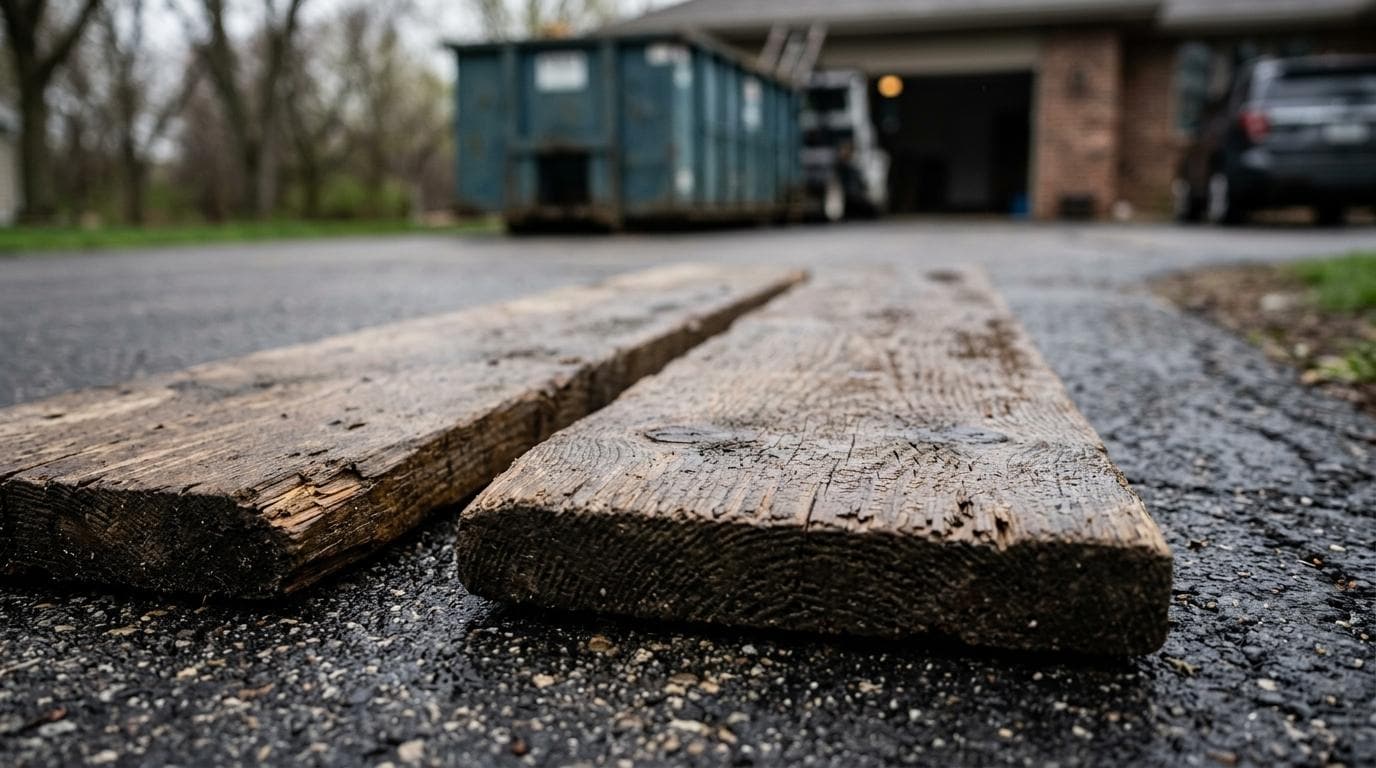
Next, think surface protection. Protective boards are useful on asphalt, decorative concrete, and driveways that have already seen freeze-thaw wear. 3D Solutions, Inc. notes driveway-protection boards as part of its service approach, which is especially helpful during wet Iowa conditions.
Then verify access rules. If the dumpster must sit on a street instead of a private driveway, check local permit rules with the city. Waterloo, Cedar Falls, and other municipalities can treat street placement differently. Pro tip: overhead lines are a bigger issue than width, so always look up before you book.
What can go in a garage cleanout dumpster, and what usually needs special handling?
Most garage cleanout dumpsters accept common nonhazardous junk, but batteries, chemicals, and certain appliances need approval or separate disposal. In Black Hawk County and Bremer County, the safest move is to confirm restricted items before delivery day.
Garage cleanouts usually create a mixed load: cardboard, broken shelves, old storage bins, wood scraps, bagged trash, and worn-out household items. That is normal roll-off material. Problems start when the pile includes liquids, automotive fluids, tires, fluorescent bulbs, or electronics.
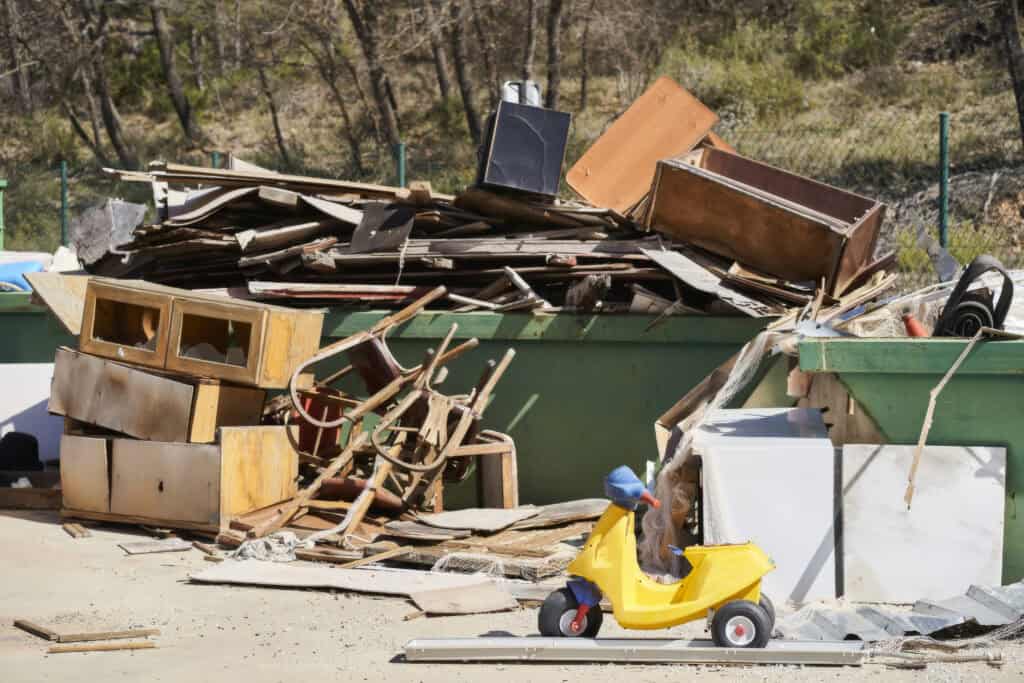
A common misconception is that anything stored in the garage can go in the dumpster. That is not how landfill rules work. If an item contains refrigerant, fuel, mercury, or a rechargeable power source, it often needs a different disposal path.
- Usually allowed: broken shelving, bagged household trash, boxes, toys, nonhazardous garage clutter
- Ask first or expect added charges: appliances, tires, some mattresses, light bulbs, certain electronics
- Never load without approval: paint, gasoline, solvents, propane cylinders, car batteries
How should you load a garage cleanout dumpster to avoid extra fees or unsafe pickup?
Load the dumpster flat, even, and below the top rail. For 20-yard and 30-yard roll-offs, safe loading is what prevents pickup delays, weight surprises, and the last-minute reshuffling nobody wants.
Step 1 is to place broad, flat items on the bottom. Shelves, broken tables, and collapsed boxes create a stable base. Step 2 is to spread heavy items across the floor instead of building one dense corner. Even distribution helps with transport and keeps loading safer.
Step 3 is to break down anything with empty space. Cardboard boxes, particle-board cabinets, and plastic shelving waste a surprising amount of volume when left intact. If the load is approaching the top edge, stop and compact only with hand tools, never by climbing inside and stomping on unstable debris.
Pro tip: “If it fits, it ships” is false. Roll-off containers must be hauled level for road safety. If material sticks above the rim, the driver may not be able to remove it until the load is brought down. That matters even more when overage fees are weight-based, like the listed $43 per extra ton on the 20-yard page.
Is a garage cleanout dumpster cheaper than junk removal or multiple dump runs?
A dumpster is usually cheaper when the garage has more than a few cubic yards of debris and you can do the loading yourself. In Denver and Cedar Falls, the math often favors a roll-off once labor, fuel, and disposal trips are counted honestly.
The published starting rates help here. A 20-yard dumpster starts at $335 and a 30-yard starts at $355, both with up to 14 days included. If your garage would require four, five, or six self-haul trips, your cost is not just landfill fees. It is gas, time, vehicle wear, and lost weekends.
Junk removal crews can be the better choice if labor is the hard part. If the issue is heavy lifting, limited mobility, or a very fast deadline, labor has value. The trade-off is price structure. Crew-based services often charge by how much space your junk occupies in their truck, plus labor.
If you can sort and load on your own, a roll-off usually gives better cost control. If you cannot, a removal crew may save the project even if the invoice is higher.
How long should you keep a dumpster for a garage cleanout?
For most homeowners, 7 to 14 days is ideal, and 3D Solutions, Inc. includes up to 14 days with its rentals. That timeline gives enough room to sort carefully, pause for donation runs, and finish without rushing the last load.
A garage cleanout rarely happens in one pass. One weekend often goes to sorting and staging, while the next handles final loading and sweep-out. That is why longer included rental periods matter. They let you make better decisions instead of throwing away items just to beat a pickup deadline.
Extensions are also straightforward. The 20-yard page lists extra rental time at $5 per day, which is modest compared with rebooking a second dumpster because the first one left too early. Common misconception: a shorter rental always saves money. When two weeks are already included, using the full window can reduce stress at no extra base cost.
When should you book same-day dumpster delivery for a garage cleanout in the Cedar Valley?
Same-day delivery makes sense when a deadline is real and the debris is already identified. In Waterloo, Cedar Falls, and Denver, urgent bookings are most useful for move-outs, tenant turnovers, contractor starts, or failed garage-sale leftovers.
If the cleanout depends on a closing date, inspection, or new tenant arrival, speed matters. The same is true after storm cleanup or when a remodeling crew needs the garage emptied before materials arrive. Same-day service is helpful only if the site is actually ready. If cars still block the driveway or prohibited items are mixed in, urgency can create mistakes.
For planned weekend cleanouts, earlier is better. Fridays and Saturdays tend to fill faster, especially in busy moving and remodeling periods. If you know the debris type, the driveway measurements, and whether a 20-yard or 30-yard container fits the scope, contacting a local provider early gives you the best shot at the date and size you want.
If your garage is already beyond curbside volume, the fastest path is simple: identify the debris mix, estimate volume, and contact a local dumpster company that serves Denver, Waterloo, Cedar Falls, Waverly, and the surrounding Cedar Valley.
Garage Cleanout Dumpster FAQs for the Cedar Valley
Do I need a permit to place a garage cleanout dumpster on the street in Waterloo or Cedar Falls?
If the container sits on your private driveway, no permit is required. Street placement is treated differently. Waterloo, Cedar Falls, and other Cedar Valley municipalities may require a right-of-way or obstruction permit for any roll-off that occupies a public road, lane, or sidewalk. Rules vary by city and sometimes by neighborhood, so call your local public works office before booking. Most garage cleanouts in Denver, Waverly, and the surrounding area sidestep the issue by using the driveway, which is also faster and easier on access.
Can Iowa winter weather affect garage cleanout dumpster delivery?
Yes. Snow, ice, and standing water all affect where a roll-off can safely be placed. Drivers cannot set a loaded container on a sheet of ice or push through a deep snowbank, so clearing and salting the delivery path matters during Cedar Valley winters. Frozen pavement usually holds up well under the container, but a thawed driveway during a wet stretch is more vulnerable to indentation. Protective boards help in both situations. If a storm is forecast during your rental window, schedule loading days around the weather rather than against it.
What should I do with paint, gasoline, and other hazardous garage items?
These items cannot go in the dumpster, but Black Hawk County and Bremer County both run household hazardous waste programs that accept paints, solvents, automotive fluids, and similar chemicals. Latex paint can usually be dried out with cat litter or a hardener, then disposed of as regular trash once it is fully solid. Oil-based paints, gasoline, propane cylinders, and pesticides should go to a county collection site. Sorting these out before the dumpster arrives keeps the load compliant and avoids surprise charges at pickup.
Can I share a garage cleanout dumpster with a neighbor?
Yes, and it is a smart way to split costs when both households have moderate amounts of debris. A 30-yard roll-off is often large enough to cover two side-by-side garage cleanouts on the same block in Denver, Waterloo, or Waverly, especially when most of the load is bulky but lightweight. Coordinate placement so both driveways have working access, agree on heavy items in advance, and split the rental fee. Just keep the combined load level with the top rail and within the included weight allowance.
One thing to keep in mind: whoever books the rental is responsible for the full contents of the container. If a neighbor adds prohibited items or the combined load exceeds the included weight allowance, any fees or pickup delays fall on the account holder. A quick conversation about what each household plans to load, and a hard no on hazardous items, goes a long way before the dumpster arrives.
Will a garage cleanout dumpster damage my driveway?
Properly placed roll-offs rarely cause damage, but decorative concrete and older asphalt are more sensitive than people expect. The wheels and rails on a loaded container concentrate weight on small contact points, which can mark softened asphalt during summer heat or stamped concrete year round. 3D Solutions, Inc. uses driveway-protection boards under the container to spread the load and reduce contact pressure. For older driveways with visible cracks, walk the placement zone with the driver before drop-off to pick the safest position.
What happens to my debris after the dumpster is hauled away?
The loaded container is taken to a regional transfer station or landfill, where it is weighed and sorted. Scrap metal is often pulled before final disposal, and certain materials may be diverted, but roll-off service is not the same as curbside recycling. If you want to keep clean cardboard, working appliances, or salvageable wood out of the landfill, separate those items before loading. For most garage cleanouts in the Cedar Valley, the bulk of the debris is mixed household waste that ends up at a permitted disposal site.
How early should I book a garage cleanout dumpster around a move?
Two to three weeks before move day is the safer window. That lead time lets you book the size you actually want, line up delivery with your packing pace, and keep the full 14-day rental period available for last-minute additions. Same-day delivery is often possible across the Cedar Valley, but waiting until move week limits your choices on size, drop date, and where the container sits in the driveway. Earlier booking also makes it easier to coordinate around closing dates, painters, contractors, or a moving truck arrival.
Can I have a garage cleanout dumpster dropped on gravel or grass instead of a driveway?
Yes, in most cases. Gravel is usually a solid surface for roll-off placement as long as it is compacted and level. Loose or shifting gravel can make it harder for the truck to position the container precisely, so clear any deep ruts or soft spots before delivery. Grass is trickier. A loaded roll-off concentrates significant weight on a small contact area, and the wheels and rails can sink into soft ground, especially after rain or during Iowa’s spring thaw. If grass is the only option, driveway protection boards help distribute the load and reduce rutting. For large or heavy loads, a gravel or paved surface is the safer choice. If you are unsure whether your surface will hold, mention it when you book and we can walk you through the best placement options for your property.